From the first conversation to the day you start paying rent: what to expect, what to prepare, and where the deal is really negotiated. Read it here, or download the PDF at the bottom of the page.
Leasing commercial space is one of the biggest commitments your business will make. Most of the important decisions happen before you sign anything. This guide walks through each step in plain English: what to expect, what I'll need from you, and where the money is negotiated.
A team of professionals helps me carry out each step, from market research and transaction coordination to space planners, architects, contractors and real estate attorneys. I'm the team lead and strategist: I set the plan, run every negotiation, and make sure you get the best space on the best terms.
Greg Cooper, J.D. · Broker Associate, Kuper Sotheby's International Realty
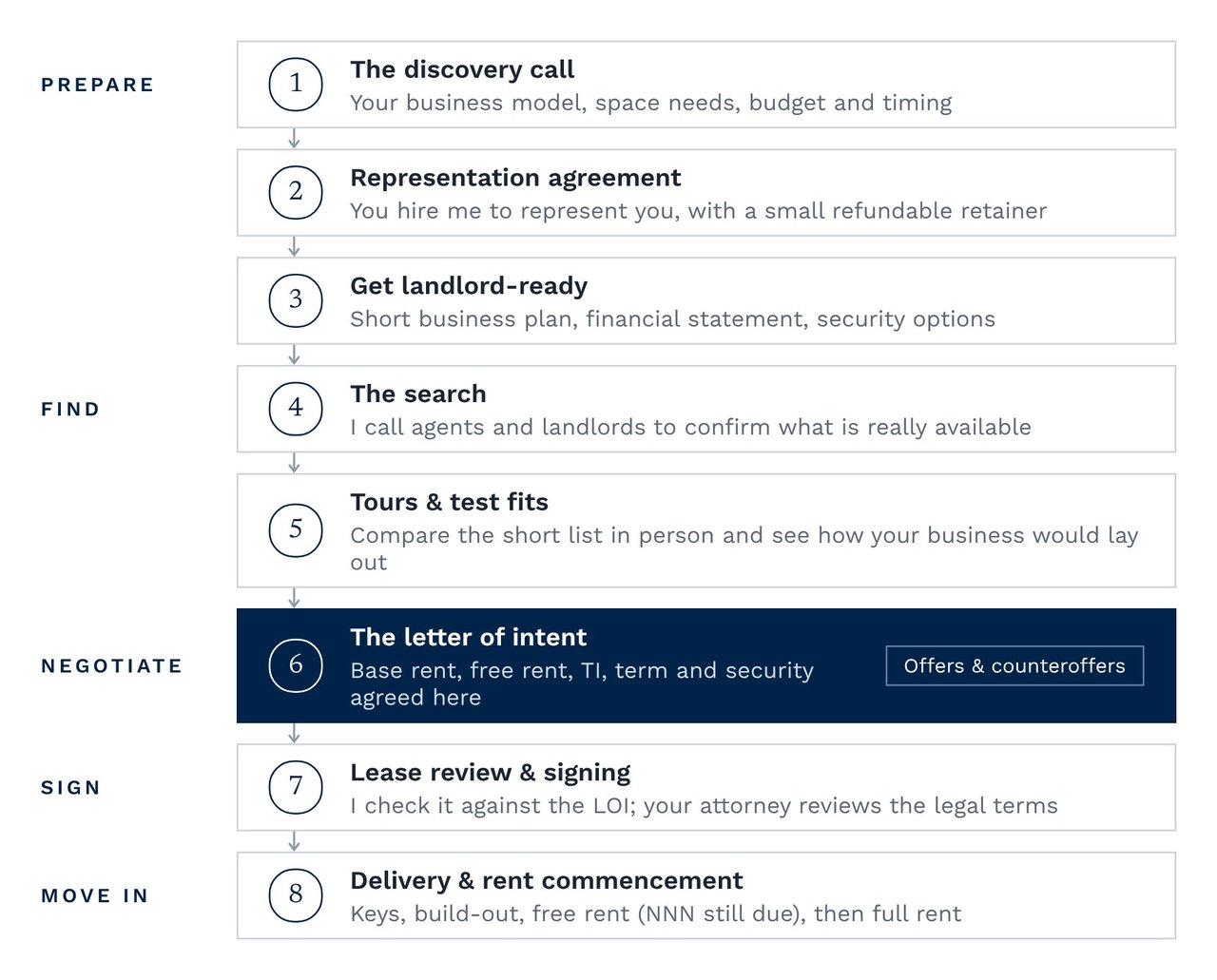
Eight steps from our first conversation to your first rent payment. The deal is set at the letter of intent, before the lease is ever drafted, so that's where most of the negotiating happens.
Everything starts with your business, not buildings: how you make money, how you operate and where you want to be in three to five years.
We'll cover your business model, how you use space, how much room you need today and to grow, location, must-haves (parking, signage, power, doors, zoning), timing and budget. You'll leave with a clear picture of what we're looking for and what to prepare next.
After our call I'll send a tenant representation agreement. It makes it official that I represent you, not the landlord, and spells out how I'm paid.
The landlord pays the commissions for both their agent and yours as part of signing a new tenant. I ask for a small retainer up front, generally about 10% of the expected commission. It works like a retainer you'd give an attorney or CPA: it confirms we're both committed, and it's refunded once the landlord pays.
A landlord is about to make a multi-year bet on your business, often spending real money on improvements before you pay a dollar of rent. The tenants who get the best terms make that bet easy to approve. Two documents do most of the work.
A short business plan (2 to 4 pages): what you do and how long you've operated, the owners and key people, your customers and why this location fits, revenue history or projections, and how you'll fund the move and build-out.
A financial statement: 2 to 3 years of profit and loss statements and balance sheets (or tax returns), a personal financial statement from each owner, and recent bank statements. Thin financials are common and not a dead end; it usually means the landlord will ask for extra security.
Beyond a normal deposit, many landlords ask for a backstop in case the business can't pay. A personal guarantee is a signed promise: "If my business doesn't pay the rent, I will." No cash leaves your pocket at signing, and to collect, the landlord must sue and win.
A letter of credit is a bank's promise to pay the landlord a set amount on demand, within days. You usually keep cash at the bank equal to the full amount, plus an annual fee of about 0.75% to 2%.
How I negotiate it: I lead with a guarantee and work to keep it. Either way, the goal is a capped amount that steps down each year. For example, a $200,000 guarantee might drop to $150,000, $100,000 and $50,000, then $0 after year 5.
Rent is quoted as a yearly price per square foot, in two parts added together. Base rent is the landlord's rent for the space; it's fixed in the lease and usually rises a set amount each year (often around 3%). NNN ("triple net") is your pro rata share of the building's property taxes, insurance and common area maintenance.
"Pro rata" means in proportion to your size. Your 5,000 sq ft in a 50,000 sq ft building is 10%, so you pay 10% of its costs: $400,000 a year × 10% = $40,000, or $8.00 per sq ft.
Example: 5,000 sq ft at $18.00 base + $8.00 NNN = $26.00 per sq ft per year. $26.00 × 5,000 ÷ 12 = $10,833.33 a month ($7,500.00 base rent + $3,333.33 NNN).
Why NNN changes: base rent is locked in; NNN is not. The landlord estimates costs each year and bills your share monthly, then compares the estimate to actual costs after year-end and sends a catch-up bill or a credit. Ask for two to three years of NNN history and keep a small cushion for the true-up.
Listing websites are a starting point, not the answer. They're rarely up to date: leased spaces still show as available, rents are stale, and the best options are often never posted.
That's why I call listing agents and landlords directly to confirm what's really available, whether anyone else is negotiating, the real asking rent and NNN, and what the landlord will contribute. My team and I also tap our network for off-market and soon-to-be-vacant spaces, so you get a short list of spaces that truly fit, with apples-to-apples monthly costs.
We tour the short list together, usually three to six spaces in a day or two, looking at layout and flow, condition, building systems (A/C, power, plumbing, ceiling height, doors), access and parking, neighbors and signage, and room to grow.
What is a test fit? When a space needs work, I bring in an architect or space planner to draw a test fit: a simple floor plan showing how your offices, work areas, equipment and storage would lay out. A contractor can price the build-out from that plan, so we know the real cost before we make an offer.
The LOI is a short, mostly non-binding summary of the main deal terms: space and term, base rent and yearly increases, free rent, TI allowance, security, renewal and expansion options, permitted use and the landlord's work. What we win here is hard to change once the lease is drafted, so this is where most of the negotiating happens.
The longer the term, the more TI. Three years is generally the minimum, most landlords want five to seven, and they love ten. The landlord earns back improvement dollars through your rent, so more years of rent means more they can put into your space up front. Base rent and TI are linked: more TI usually means higher rent or a longer term, so I weigh your total cost over the life of the lease.
TI is normally paid once the improvements are finished to the landlord's satisfaction, so plan to fund construction up front and be reimbursed, unless the landlord does the build-out itself. Expect a few rounds of offers and counteroffers.
Once the LOI is signed, the landlord's attorney drafts the lease, the binding contract, often 30 to 80 pages. I check it line by line against the LOI: size, rent, increases, free rent, TI, security, options and dates. Your attorney reviews the legal terms. This usually takes two to six weeks.
Signing the lease isn't the day you start paying rent. Three dates matter. Delivery date: you get the keys and build-out starts. Rent commencement: rent payments begin, often a set number of days after delivery. Free rent period: if negotiated, it usually starts at rent commencement.
Free rent usually means free base rent only. You typically still pay your pro rata share of NNN during the free months: in our example, $3,333.33 a month (not $0), then the full $10,833.33 after that.
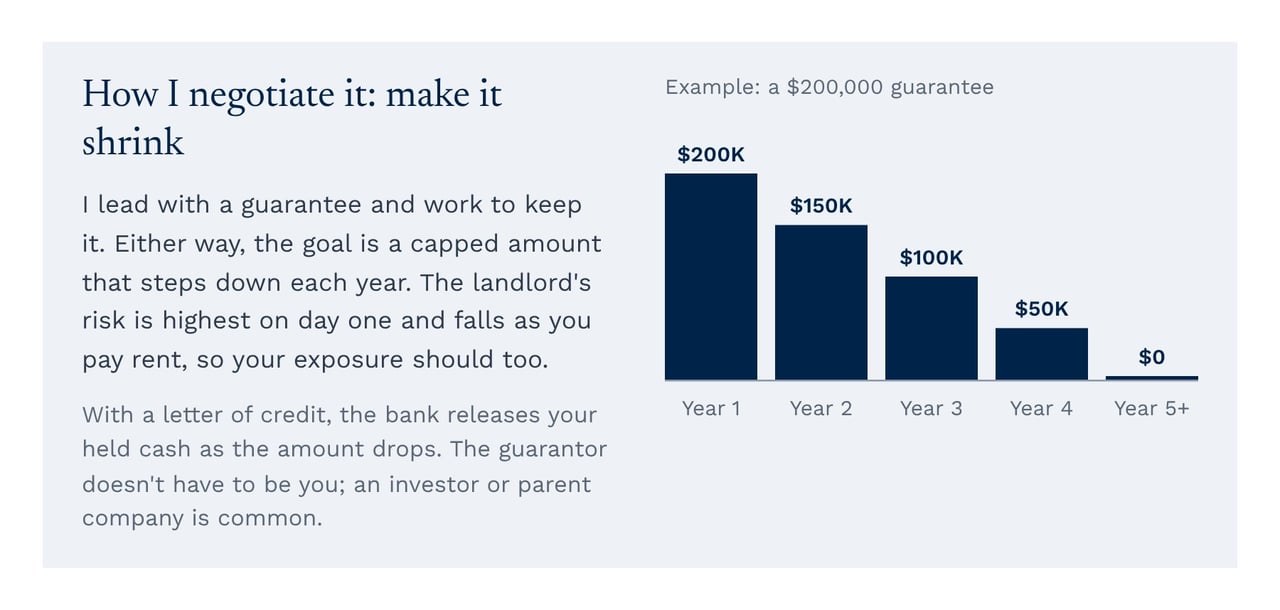
The landlord's risk is highest on day one and falls as you pay rent, so your exposure should too. I negotiate a capped guarantee or letter of credit that steps down each year until it's gone.
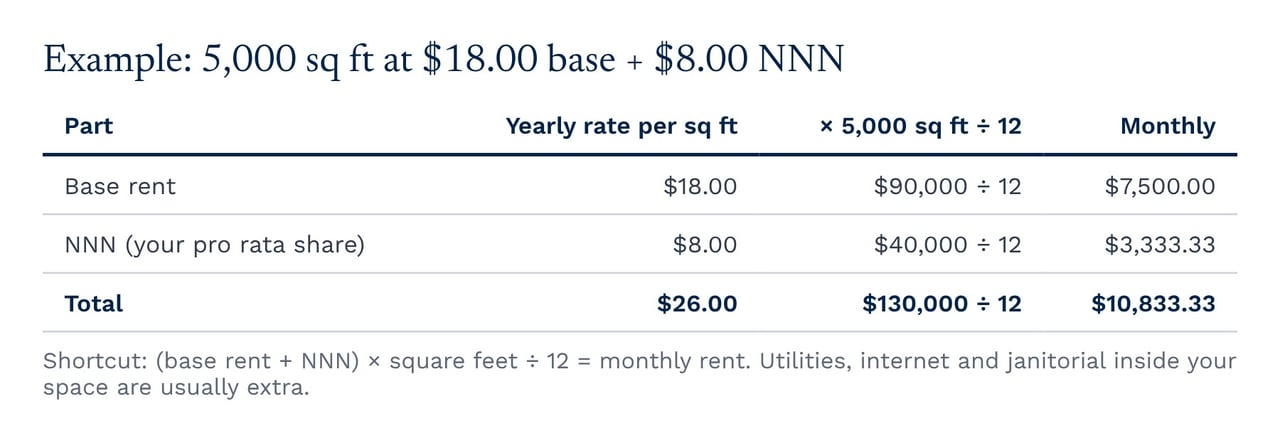
Base rent plus your pro rata share of NNN, worked out for a 5,000 sq ft space. Base rent is locked in; NNN is estimated each year and trued up after year-end.
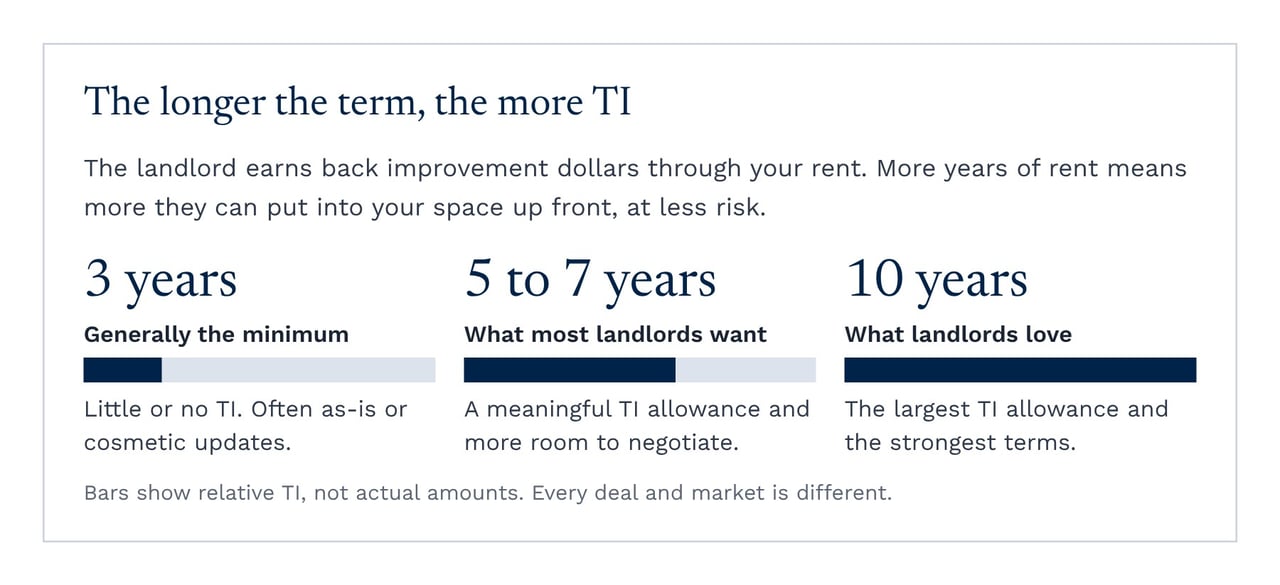
Three years is generally the minimum, most landlords want five to seven, and they love ten. More years of rent means more they can put into your space up front.
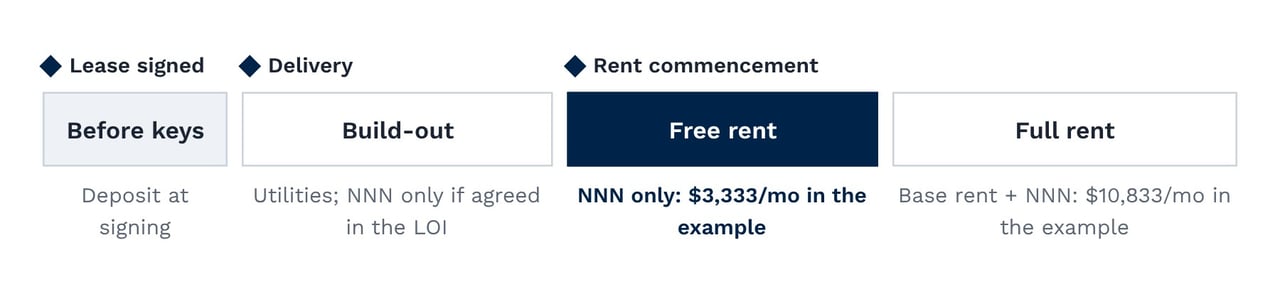
You get the keys on the delivery date, and rent starts on the rent commencement date. Free rent usually covers base rent only, so plan to pay your pro rata share of NNN during the free months.
Get the full 12-page PDF, with the charts, worked examples and glossary, to read offline or share with your partners. Enter your name and email and the download opens right away.